
FOSDEM 26
Following the Paper Trail


“The street finds its own uses for things.”
— William Gibson, Burning Chrome
🙋♂️ This report began not in the rooms where the conference unfolded, but in its paper trail — the documentation, the articles, the quiet residue of what people chose to record. And in those traces, a pattern surfaced: a shift from demonstrating working systems to building the structures that allow them to endure.
Introduction
Most software infrastructure serving public administrations, healthcare systems, and critical services today operates under licensing regimes whose enforceability has never been tested, compliance toolchains whose outputs have never been validated, and governance structures whose accountability mechanisms exist only on paper. The dominant model treats this as operationally acceptable: proprietary vendors provide assurances in place of verifiable evidence, regulatory compliance becomes a documentation exercise rather than a technical achievement, and the question of who controls the infrastructure that runs society is answered by procurement contracts rather than institutional design. Based on program structure, devroom elevation, and thematic clustering, FOSDEM 2026 suggests a transition from system validation toward institutional consolidation.
What Happened
FOSDEM 2026 ran 31 January – 1 February 2026 at ULB Campus Solbosch, Brussels — the 26th edition of Europe’s largest free and open source software conference, volunteer-organized, free to attend, and recorded in full. Approximately 8,000+ participants attended
[Self-Reported: fosdem.org/2026/, 2026-02-01],
with 1,216 speakers presenting 1,079 events across 71 tracks, according to published schedule metadata
[Self-Reported: FOSDEM schedule, 2026-01-31].
Seven new devrooms marked structural evolution from FOSDEM 2025. SBOMs and Supply Chains elevated from scattered Legal & Policy talks to a full-day track with 12+ sessions — supply chain transparency has community mass. CRA in practice separated implementation from policy discussion, signalling practitioners are acting on compliance deadlines rather than debating them. Building Europe’s Public Digital Infrastructure consolidated and expanded the 2025 Government Collaboration devroom, reflecting public sector open source as a recognised pillar of European digital policy rather than a niche concern. Nix and NixOS gained its first dedicated devroom after years in Declarative/Minimalistic Computing. Local-First, sync engines, CRDTs formalized an emerging community around offline-first architectures. Package Management and RISC-V returned as dedicated tracks after reduced presence in 2025.
Analysis
hola.events harvests actionable contributions from technology events — techniques, tools, and patterns that practitioners can learn from and apply. This assessment covers FOSDEM 2026 (Brussels, 31 January & 1 February 2026), the 26th edition of Europe’s largest open source conference.
The four principles guiding what we look for:
Human Autonomy - techniques for verifiable, user-serviceable systems
Open Licensing - compliance tools, enforcement mechanisms, governance frameworks
Local Ownership - federated and self-hosted architectures enabling jurisdiction-appropriate deployment
Accountable Hands - governance structures with documented, replicable patterns
This assessment cites 18 sources, each linking to a specific talk or project and accompanied by an insight sentence explaining what it demonstrates. Attendance figures are self-reported by event organisers and tagged accordingly. AI-assisted triage was used for initial session scanning; all content judgments are human.
Guided Insights
🔎 ✊ Human Autonomy
Five contributions demonstrate systems where users can verify what software does, modify its behavior, and operate infrastructure without depending on external authority — moving from prototype demonstrations to documented patterns for replication.
Eilean: NixOS as Self-Hosted Federated Services Platform: Ryan Gibb presented Eilean — a NixOS-based system that generates a complete operating system deployment from a domain name and a desired service list, enabling communities to self-host federated services (Matrix, Mastodon, Email) with a single declarative configuration [Operational:2026]. The project inverts the centralisation model: instead of concentrating data in proprietary platforms, Eilean enables “digital islands” — self-hosted hubs under community control. Configuration is declarative and reproducible via NixOS.[1]
TAPPaaS: NixOS Private Cloud for Real Organisations: A complete resilient private cloud architecture based entirely on NixOS — covering upgrades, failure recovery, and restoration cycles — designed for organisations beyond homelab experimentation [Operational:2026]. The talk documented specific architectural decisions for handling production failure modes, not just happy-path deployments. NixOS’s declarative foundation makes the entire infrastructure configuration verifiable and replicable.[2]
Upstream Embedded Linux on RISC-V SBCs: Year-Over-Year Progress: Andreas Färber presented three years of mainline Linux upstreaming progress for RISC-V single-board computers (Banana Pi BPI-F3, BPI-RV2, and others) — documenting kernel support status in 2024, 2025, and 2026 [Operational:2024–2026]. The talk makes RISC-V concrete: specific SoCs, specific boards, specific upstreaming blockers resolved, specific features still pending. For practitioners needing auditable hardware, the talk provides the current status of what actually works on commercially available open-architecture boards.[3]
Reticulum: Resilient Mesh Networking for Austere Environments: The Reticulum community brought together practitioners building with Reticulum — an open networking stack designed for decentralised communication across heterogeneous physical links (Wi-Fi, Bluetooth, LoRa, packet radio) without internet dependency [Operational:2026]. The session presented a draft formal protocol specification, documented active deployment experience, and covered a governance transition as the lead developer steps back. Reticulum is directly relevant to communities needing communications that function under internet shutdowns or fragile infrastructure.[4]
pkgconf 3.x: Build-time SBOMs for C/C++ Projects: The pkgconf team demonstrated pkgconf 3.x extensions that generate build-time SBOMs for C/C++ projects directly from the pkg-config dependency database [Operational:2026]. The talk included slides and a live demo. This closes a gap: traditional C/C++ projects had no straightforward path to build-time SBOM generation. The pkg-config database already encodes build dependency relationships; pkgconf 3.x makes them queryable as SBOMs.[5]
🔎 🖐️ Open Licensing
Five contributions address the compliance, enforcement, and governance infrastructure that makes open licensing operationally meaningful rather than rhetorically aspirational.
Zephyr RTOS: SPDX SBOM Integration for Embedded Firmware: The Zephyr RTOS project documented their integration of SPDX-based SBOM generation into the CMake build system, addressing specific embedded firmware challenges: vendor HALs, out-of-tree modules, and binary blobs that don’t map cleanly to source code SBOMs [Operational:2026]. The talk also presented ongoing exploration of SPDX 3 to describe build configuration and AI/ML artifacts. Directly relevant to CRA compliance for embedded product manufacturers. Zephyr is a Linux Foundation project; patterns are transferable to other embedded firmware projects with similar HAL complexity.[6]
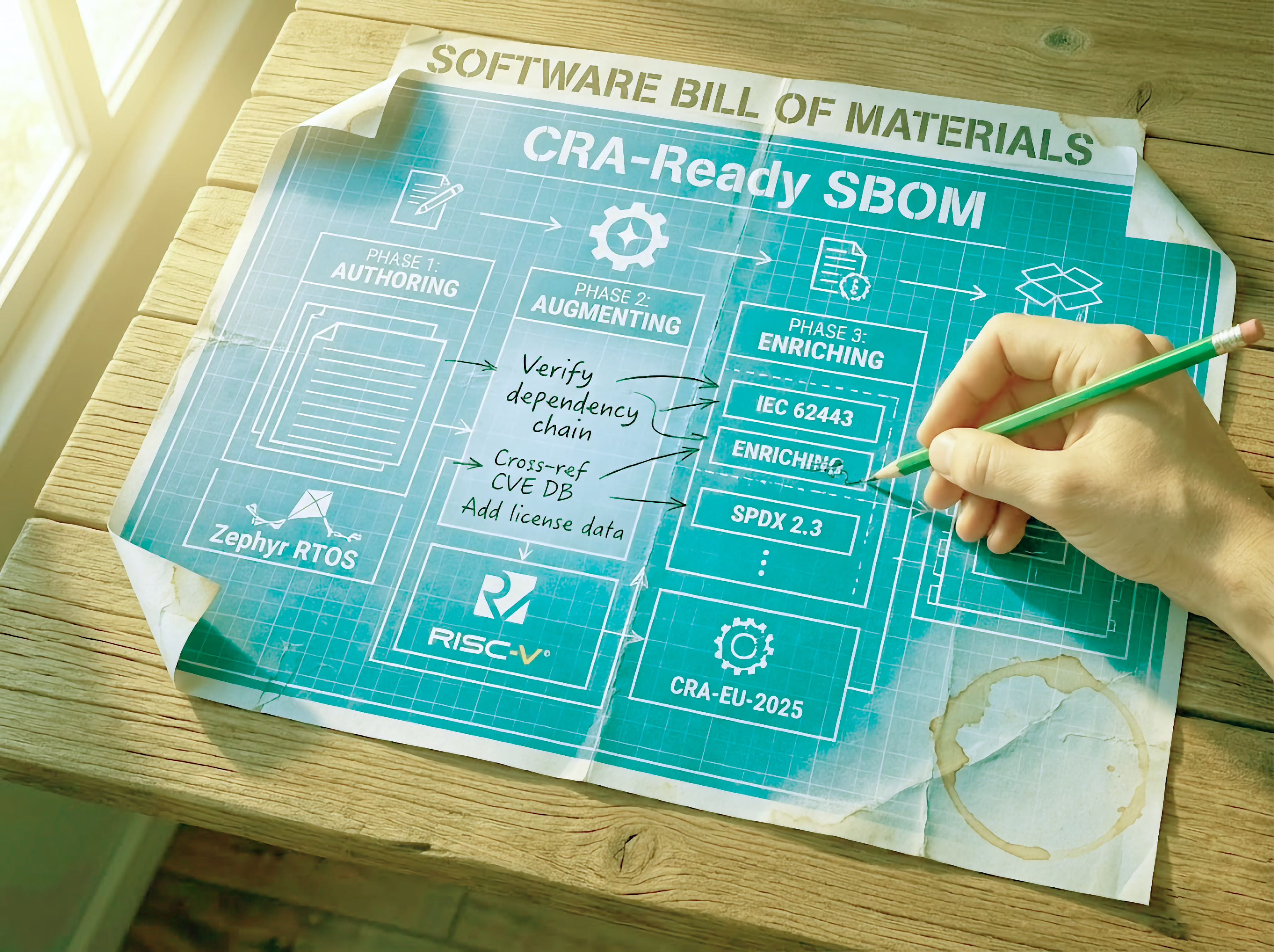
CRA-Ready SBOMs: Four-Phase Generation Blueprint: A CISA SBOM working group co-leader presented a practical four-phase blueprint for CRA-compliant SBOM generation: Authoring (from lockfile), Augmenting (resolving metadata gaps), Enriching (open datasets), and Assembling (final output) [Operational:2026]. As documented in the talk, an open source implementation of the full pipeline runs inside GitHub Actions — no proprietary tools required. The blueprint goes beyond minimum CRA compliance to address the quality bar expected by regulators.[7]
Vizio GPL Lawsuit: A Historic Case for User Rights, Nearly Complete: Denver Gingerich (Software Freedom Conservancy) returned to FOSDEM to present the near-conclusion of the Vizio GPL lawsuit — the first US case where an end-user (SFC on behalf of a purchaser) sued a manufacturer for GPL compliance in federal court [Operational:US(2026)]. As documented in the talk, the case has established legal ground for copyleft enforcement by purchasers in US jurisdiction. This is the American counterpart to the German LGPL enforcement case documented in the FOSDEM 2025 harvest. Readers needing to act on this should consult qualified legal counsel for their specific circumstances.[8]
CRA – Role of Free Software: Q&A with Policy Practitioners: Alexander Sander (FSFE), Michael Schuster, and Tommaso Bernabò ran a full-hour CRA implementation session in the Legal & Policy devroom — covering specific provisions affecting free software projects, the distinction between commercial and non-commercial open source under CRA, and practical compliance pathways [Operational:EU(2025)] with full enforcement scheduled for 2027 [Proposed:EU(2027)]. The session included direct Q&A, making it a practitioner exchange rather than a policy lecture. Context: CRA was also the subject of a dedicated full-day devroom (”CRA in practice”) — this Legal & Policy session provides the policy interpretation layer above the implementation layer.[9]
Interoperability Regulation: DMA Opening iOS and Android: A Legal & Policy devroom talk examined the EU Digital Markets Act (DMA) interoperability provisions — what the regulation requires Apple and Google to open for free software applications and how FOSS projects can use these new legal access rights [Operational:EU(2024–2025)]. Directly relevant to FOSS on Mobile practitioners who have historically been blocked by platform gatekeeping. The DMA came into force in 2024; interoperability obligations became active for designated gatekeepers in 2025.[10]
🔎 👇 Local Ownership
Four contributions demonstrate federated and self-hosted architectures operating at scales from community groups to national governments — documenting the infrastructure and governance patterns that enable jurisdiction-appropriate deployment.
Sustainable Matrix at Element: AGPL Shift and Three National Deployments: As documented in the talk, Element shifted from Apache-2.0 to AGPL and released Element Server Suite (ESS) Community — an official self-hostable Matrix distribution under AGPL [Operational:2026]. The talk explicitly frames this as a sustainable business model resolution. Three national public sector deployments are now operational: Germany’s openDesk (ZenDiS), France’s La Suite (DINUM), and the Netherlands’ MijnBureau (MinBZK) [Operational:DE,FR,NL(2026)]. This is a maturation signal from the FOSDEM 2025 TI-Messenger deployment talk: in 2025, deployment at scale was announced; in 2026, the business model is resolved and ESS Community is released under AGPL.[11]
Scaling EU Open Source Products: DINUM’s Two-Year Lessons: DINUM (French Interministerial Digital Directorate) presented two years of operational experience attempting to turn national open source products into shared European products [Operational:EU(2024–2026)]. As documented in the talk, the session covered what worked, what failed, and practical lessons for cross-border public administration collaboration — including co-developing open source modules with other Member States, making reuse realistic across different administrative cultures, and using EU funding to pool resources rather than create siloed prototypes.[12]
From Policy to Practice: Open Source in the Dutch Government: Gina Plat presented the Netherlands’ journey from open source policy to practical implementation in government — covering specific decisions taken, barriers encountered, and what made adoption real rather than rhetorical [Operational:NL(2026)]. Includes context for MijnBureau (MinBZK), the Dutch national digital workspace built on Matrix/Element. The talk documents an implementation journey applicable to any national government beginning a similar transition.[13]
Fork the Government: Taiwan’s Open Source Advocacy Trajectory: Rosalind Liu presented Taiwan’s back-and-forth open source advocacy journey in government — documenting what has worked, what has been reversed, and what the current status is [Operational:TW(2016–2026)]. Significant as the first non-EU perspective in this harvest: Taiwan’s experience with digital sovereignty, open source government tooling, and the political conditions that enable or block adoption differs structurally from the European regulatory-push model. This contribution directly addresses the geographic concentration gap identified in the FOSDEM 2025 harvest.[14]
🔎 ✋ Accountable Hands
Four contributions demonstrate governance structures, funding mechanisms, and community tooling that have operated long enough to document what sustains collaboration at scale.
XMPP Federation: Engineering Interoperability at Ecosystem Scale: The XMPP Standards Foundation presented how the XMPP ecosystem — 5+ major servers, 20+ clients, all developed independently — achieves high interoperability while shipping new features at an accelerating pace [Operational:2026]. The talk was co-presented by an ejabberd server developer and a Movim client developer, documenting specific engineering patterns that enable independent projects to build interoperable features without tight coupling and without central coordination. Real-life 2025 collaboration examples were demonstrated.[15]
Funding Europe’s Open Digital Infrastructure: EU Sovereign Tech Fund Campaign: The EU-STF campaign team presented a completed feasibility study (2025) and an active political campaign for an EU Sovereign Tech Fund modeled on Germany’s successful Sovereign Tech Agency [Operational:2025]. As documented in the talk, the campaign has assembled a coalition of supporters, presented to the European Parliament and Member States, and is making a concrete policy ask for the 2028-2034 EU budget [Proposed:EU(2028–2034)]. Not hypothetical — this is operational political engagement with documented deliverables.[16]
Community Moderation in Matrix: Trust & Safety Tooling: A Decentralised Communication devroom talk demonstrated the layered Trust & Safety tooling available to Matrix communities — moderation bots, in-client safety features, and policy servers (MSC4284) [Operational:2026]. The talk demonstrated how to set up a policy server and documented which harms each tool is best suited to mitigate. Relevant to community operators needing practical moderation infrastructure, not just cryptographic guarantees.[17]
CryptPad: Private Real-Time Collaboration — Latest Updates: CryptPad — the end-to-end encrypted, self-hostable collaborative document platform — presented its latest development updates [Operational:2026]. CryptPad is a direct operational alternative to Google Docs/Microsoft 365 for organisations requiring that the platform operator cannot read document content. AGPL-licensed; self-hostable with Docker deployment; production deployments active. Relevant to any organisation needing collaborative editing with provable data sovereignty.[18]
Experimental Edges
Local-First Computing with CRDTs: The new Local-First, sync engines, CRDTs devroom (full-day Sunday) signals that local-first computing — where data lives on the user’s device and syncs opportunistically rather than requiring a cloud authority — is forming an organised community. CRDTs (Conflict-free Replicated Data Types) are the mathematical foundation enabling conflict-free merging of locally-modified data. Still experimental because tooling is fragmented, UX patterns for conflict resolution are not standardised, and most application infrastructure assumes always-connected cloud. Developer familiarity with CRDT design is low.
Watch for: Major FOSS application adopting local-first architecture; CRDT library reaching stable 1.0 in a mainstream language; public sector use case choosing local-first over client-server for offline capability.
AI Artifact SBOMs and ML Model Provenance: The Zephyr RTOS SPDX 3 work and the CRA-Ready SBOM blueprint both touch on an emerging problem: SBOMs for AI/ML components (model weights, training datasets, inference configurations) don’t map cleanly to software component SBOMs. SPDX 3 is beginning to address this but the tooling is immature. SPDX 3 AI profile is in development [Experimental:2026]; no production tooling is widely available.
Watch for: SPDX 3 AI profile ratified as standard; major ML framework integrating native SBOM generation; CRA guidance explicitly addressing AI model components.
Entry Points
1. Start here — NixOS declarative infrastructure: Eilean (github.com/RyanGibb/eilean-nix) demonstrates single-command self-hosted federated services. TAPPaaS demonstrates production resilience patterns. Both use NixOS as the foundation; configurations are verifiable and reproducible.
2. The SBOM compliance stack: CRA-Ready SBOM blueprint [7] provides the four-phase pipeline with GitHub Actions implementation. Zephyr RTOS case study [6] covers embedded firmware specifically. pkgconf [5] closes the C/C++ build-time gap.
3. Public sector open source at national scale: Element’s three national deployments [11] provide reference architectures. DINUM’s cross-border lessons [12] document what works for European collaboration. Dutch government journey [13] covers policy-to-practice transition. Taiwan [14] provides non-EU perspective.
4. Federated protocol engineering: XMPP federation talk [15] documents interoperability patterns for 5+ servers and 20+ clients. Matrix community moderation [17] covers Trust & Safety tooling.
5. The new structural tracks: SBOMs and Supply Chains devroom (https://fosdem.org/2026/schedule/track/sboms-and-supply-chains/) — 12+ sessions spanning embedded, C/C++, VEX, and AI artifacts. CRA in practice devroom — implementation-focused talks separated from policy discussion. Building Europe’s Public Digital Infrastructure devroom — consolidated public sector track with broader scope than 2025.
Our Take
This review draws on eighteen sessions that met our inclusion criteria, spanning all four principles. Together they suggest a broad and practical cross-section of activity rather than concentration in a single domain.
Human Autonomy includes work on declarative infrastructure (NixOS), upstream RISC-V hardware integration, and resilient mesh networking in constrained environments.
Open Licensing covers embedded SBOM tooling, copyleft enforcement in U.S. courts, and interoperability obligations under the DMA.
Local Ownership documents three national Matrix deployments alongside European cross-border collaboration patterns.
Accountable Hands ranges from federated protocol engineering to EU funding campaigns and trust & safety tooling.
Taken together, the material is less about speculative direction and more about implemented systems, governance mechanisms, and operational practice.
Pattern: Institutional Turn
Across the program, one pattern appears repeatedly. The dominant movement is not the arrival of new techniques, but the consolidation of existing ones into more durable structures.
By institutionalisation, we mean the emergence of governance processes, funding arrangements, regulatory alignment, and replication capacity. The distinction is important: a project may function technically without yet having the scaffolding that allows others to adopt, adapt, or sustain it.
Several signals support this interpretation: • SBOM work has evolved from scattered legal and policy sessions into a dedicated, full-day devroom. This suggests a community large enough to organise, reproduce, and specialise. • CRA discussion shifted from policy interpretation toward implementation practice, indicating that compliance is moving from debate to execution. • Public sector open source expanded in scope from collaboration discussions to framing Europe’s public digital infrastructure — a change in narrative scale and policy positioning. • Matrix/Element’s AGPL shift and the ESS Community release indicate a project moving from demonstrating scale viability to stabilising long-term sustainability.
None of these signals alone would justify the claim. Together, they suggest a shift from demonstrating that systems work to building the structures that allow them to persist and replicate.
Across the four principles, FOSDEM 2026 documents operations becoming durable frameworks.
Geographic Context
This pattern is closely tied to European regulatory and policy momentum, particularly the CRA and DMA. That is not incidental; it shapes the environment in which many of these projects operate. In that sense, the institutionalisation observed here reflects the European regulatory–funding–compliance nexus around open source infrastructure.
At the same time, the Taiwan contribution shows related dynamics emerging under different civic and political conditions. The forms differ, but the underlying move toward structural durability is comparable.
For clarity: this analysis does not claim that “open source as a whole” is institutionalising uniformly. Rather, FOSDEM 2026 captures a specific regional configuration in which open source practice, public policy, and regulatory frameworks are becoming structurally intertwined.
AI Role
AI-assisted triage was used to scan 71 track listings, flag sessions with strong demonstration signals across the four principles, and structure the FOSDEM 2025/2026 comparison. All flagged sessions were reviewed against actual talk content — 15 flagged sessions were downgraded after review confirmed discussion-only content. All contribution descriptions, quality assessments, and reference selections are the result of human judgment. URLs were verified against live fosdem.org/2026/schedule/ pages and video.fosdem.org/2026/ recordings where available.
References
References are grouped by hola principles. Each links to the specific talk or project that demonstrates the contribution described.
📖 ✊ Human Autonomy
[1] Eilean
Self-hosted digital islands. FOSDEM 2026, 2026-02-01
https://fosdem.org/2026/schedule/event/UERPXG-eilean/
🕯️ Demonstrates single-command self-hosted federated services (Matrix, Mastodon, Email) with declarative NixOS configuration — enabling communities to operate “digital islands” under their own control without external dependency.
[2] TAPPaaS
TAPPaaS: A resilient, trusted, automated private cloud based on NixOS. FOSDEM 2026, 2026-02-01.
https://fosdem.org/2026/schedule/event/EAPNQF-tappaas_a_resilient_trusted_automated_private_cloud_based_on_nixos
🕯️ Documents production resilience patterns for NixOS private cloud architecture — covering upgrades, failure recovery, and restoration cycles for real organisations beyond homelab experimentation.
[3] Upstream Linux
Färber, Andreas. Upstream Embedded Linux on RISC-V SBCs: The Past, Present and Future. FOSDEM 2026, 2026-01-31.
https://fosdem.org/2026/schedule/event/LX3NNU-upstream-embedded-linux-on-risc-v-sbcs/
🕯️ Documents three years (2024–2026) of mainline Linux upstreaming progress for commercially available RISC-V single-board computers — providing current status of what actually works on open-architecture hardware.
[4] Reticulum
Reticulum community. The Future of Reticulum: Community Roadmap and Protocol Specification. FOSDEM 2026, 2026-02-01. https://fosdem.org/2026/schedule/event/NEN89E-future-of-reticulum/
🕯️ Presents draft formal protocol specification and active deployment experience for resilient mesh networking across heterogeneous physical links (Wi-Fi, Bluetooth, LoRa, packet radio) — designed for communication under internet shutdowns or fragile infrastructure.
[5] SBOMs with pkgconf
pkgconf maintainers. C/C++ Build-time SBOMs with pkgconf. FOSDEM 2026, 2026-01-31.
https://fosdem.org/2026/schedule/event/ELPHEA-pkgconf-sbom/
🕯️ Demonstrates pkgconf 3.x generating build-time SBOMs for C/C++ projects directly from pkg-config dependency database — closing the build-time SBOM gap for traditional C/C++ projects.
📖 🖐️ Open Licensing
[6] Zephyr RTOS
Zephyr RTOS contributors. SBOMs for Embedded Firmware: The Zephyr RTOS Case Study. FOSDEM 2026, 2026-01-31. https://fosdem.org/2026/schedule/event/ZXJD8E-sboms_for_embedded_firmware_the_zephyr_rtos_case_study/
🕯️ Documents SPDX SBOM integration into CMake build system for embedded firmware with vendor HALs, out-of-tree modules, and binary blobs — directly addressing CRA compliance challenges for embedded product manufacturers.
[7] CRA-Ready SBOMs
CISA SBOM Working Group co-leader. CRA-Ready SBOMs: A Practical Blueprint for High-Quality Generation. FOSDEM 2026, 2026-01-31.
https://fosdem.org/2026/schedule/event/UYTGWA-sbom-generation/
🕯️Presents four-phase CRA-compliant SBOM generation pipeline (Authoring, Augmenting, Enriching, Assembling) with open source GitHub Actions implementation — no proprietary tools required.
[8] The Vizio lawsuit
Gingerich, Denver. The story of the Vizio lawsuit - a historic case for user rights, nearly complete! FOSDEM 2026, 2026-01-31. https://fosdem.org/2026/schedule/event/GSERGW-the_story_of_the_vizio_lawsuit_-_a_historic_case_for_user_rights_nearly_complete/
🕯️ As documented in the talk, the near-conclusion of the first US case where an end-user sued a manufacturer for GPL compliance in federal court — establishing legal ground for copyleft enforcement by purchasers in US jurisdiction. Readers needing to act on this should consult qualified legal counsel.
[9] CRA and Free Software
Sander, Alexander; Schuster, Michael; Bernabò, Tommaso. CRA – Role of Free Software and Q&A. FOSDEM 2026, 2026-01-31. https://fosdem.org/2026/schedule/event/QEZ3LB-cra_-_role_of_free_software_and_q_a/
🕯️ Provides policy interpretation layer for CRA provisions affecting free software — covering commercial vs non-commercial distinction and practical compliance pathways as CRA moves toward 2027 enforcement.
[10] Interoperability
[Speaker — Legal & Policy devroom]. Interoperability regulation in the EU: Opening iOS and Android for Free Software. FOSDEM 2026, 2026-01-31. https://fosdem.org/2026/schedule/event/TQS7LM-interoperability-dma-apple-google/
🕯️ Examines DMA interoperability provisions requiring Apple and Google to open platforms for free software applications — directly actionable for FOSS mobile developers historically blocked by gatekeeping.
📖 👇 Local Ownership
[11] Element
Element/Matrix.org team. Sustainable decentralised comms at Element. FOSDEM 2026, 2026-02-01.
https://fosdem.org/2026/schedule/event/BRRQYU-sustainable-matrix-at-element/
🕯️ Documents Element’s AGPL licensing shift and ESS Community release alongside three operational national deployments (Germany’s openDesk, France’s La Suite, Netherlands’ MijnBureau) — demonstrating business model resolution for national-scale federated infrastructure.
[12] DINUM
DINUM (French Interministerial Digital Directorate). Scaling national open-source products across Europe: lessons learned from two years of cross-border state collaboration. FOSDEM 2026, 2026-02-01.
https://fosdem.org/2026/schedule/event/FQWYHW-scaling_national_open-source_products_across_europe_lessons_learned_from_two_yea/
🕯️ Presents two years of operational experience (2024–2026) turning national open source products into shared European products — documenting what worked, what failed, and practical lessons for cross-border collaboration.
[13] Dutch Government
Plat, Gina. From Policy To Practice; Open Source in The Dutch Government. FOSDEM 2026, 2026-01-31.https://fosdem.org/2026/schedule/event/BNPJ7P-from-policy-to-practice-open-source-in-gov/
🕯️ Documents Netherlands’ journey from open source policy to practical government implementation — covering specific decisions, barriers, and what made adoption real rather than rhetorical, with MijnBureau as operational context.
[14] Fork the Government
Liu, Rosalind. Fork the Government: The Back and Forth Open Source Advocacy Road in Taiwan. FOSDEM 2026, 2026-01-31. https://fosdem.org/2026/schedule/event/9HAMJC-fork_the_government_the_back_and_forth_open_source_advocacy_road_in_taiwan/
🕯️ First non-EU Local Ownership contribution in two FOSDEM editions — documents Taiwan’s multi-year (2016–2026) open source advocacy trajectory in government, including what has worked, what has been reversed, and current status.
📖 ✋ Accountable Hands
[15] XMPP
XMPP Standards Foundation (ejabberd + Movim developers). Engineering XMPP Federation: Building Messaging, Voice & Social Features Across Independent Projects. FOSDEM 2026, 2026-02-01.
https://fosdem.org/2026/schedule/event/7XJL9E-engineering_xmpp_federation_building_messaging_voice_social_features_across_inde/
🕯️ Co-presented by independent server and client developers — documents engineering patterns enabling 5+ major servers and 20+ clients to achieve high interoperability while shipping new features, with 2025 collaboration examples demonstrated.
[16] EU-STF
EU-STF campaign team. Funding Europe’s Open Digital Infrastructure: A Detailed Case for an EU Sovereign Tech Fund. FOSDEM 2026, 2026-01-31.
https://fosdem.org/2026/schedule/event/KES3TH-funding_europes_open_digital_infrastructure_a_detailed_case_for_an_eu_sovereign_/
🕯️ Presents completed feasibility study (2025) and active political campaign for EU Sovereign Tech Fund — documented coalition assembled, European Parliament engagement, concrete 2028-2034 budget ask modeled on German Sovereign Tech Agency.
[17] Matrix Communities
[Speaker — Decentralised Communication devroom]. Community moderation in Matrix. FOSDEM 2026, 2026-02-01. https://fosdem.org/2026/schedule/event/JKWGWG-community_moderation_in_matrix/
🕯️ Demonstrates layered Trust & Safety tooling for Matrix communities — moderation bots, in-client safety features, policy servers (MSC4284) — with setup guidance and documented harm mitigation approaches.
[18] CryptPad
CryptPad team. CryptPad updates: latest in private real-time collaboration. FOSDEM 2026, 2026-02-01.
https://fosdem.org/2026/schedule/event/3VB7H8-cryptpad_updates_latest_in_private_real-time_collaboration/
🕯️ Presents latest updates to end-to-end encrypted, self-hostable collaborative document platform — operational alternative to Google Docs/Microsoft 365 where platform operator cannot read content, AGPL-licensed with Docker deployment.